
Gunstar Super Heroes – Treasure Trove
For those that know Treasure, the dev’s logo is a seal of quality. If you don’t happen to know them, you’ve stumbled upon a treasure trove.
Gunstar Super Heroes, or Gunstar Future Heroes as it is known in Europe, is a run and gun side-scroller that packs a frankly irresponsible amount of variety it in its short runtime. ROM’s usual Read-Only Adventure format feels ill-equipped to tackle the essence of the game so let’s make like a mid-2010s online publication and pivot to video.
What follows is an no-game-over run of the game on normal difficulty that will help illustrate my points as an accompanying piece.
Earth: Bullets and sprites
The two staples of Treasure’s catalogue become obvious from the first few minutes of gameplay. Frantic action with tight controls and impressive 2D animation.
One face button will be doing the shooting and the other will be used for jumping and melee attacks that double as navigation maneuvers. You can lock your firing direction with R so you decouple movement and aiming, while L cycles through your weapon options. Lastly, tapping R twice will fire off the weapon’s supercharge attack, spending the gauge you’ve built up. Earth’s level design and enemies are simple enough to let you get used to the feel of the games.
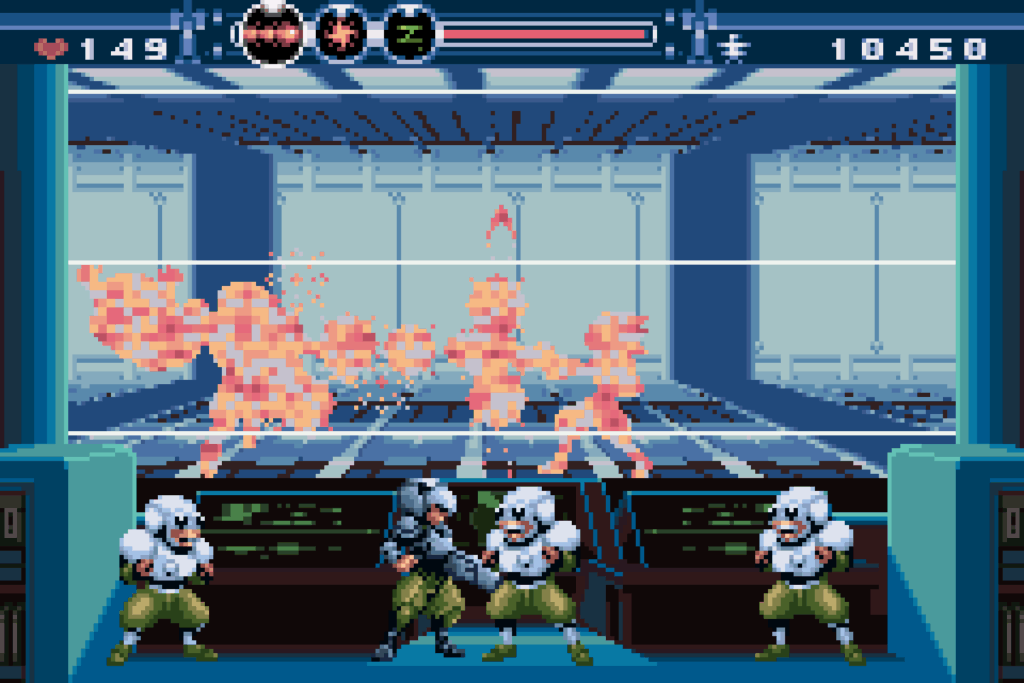
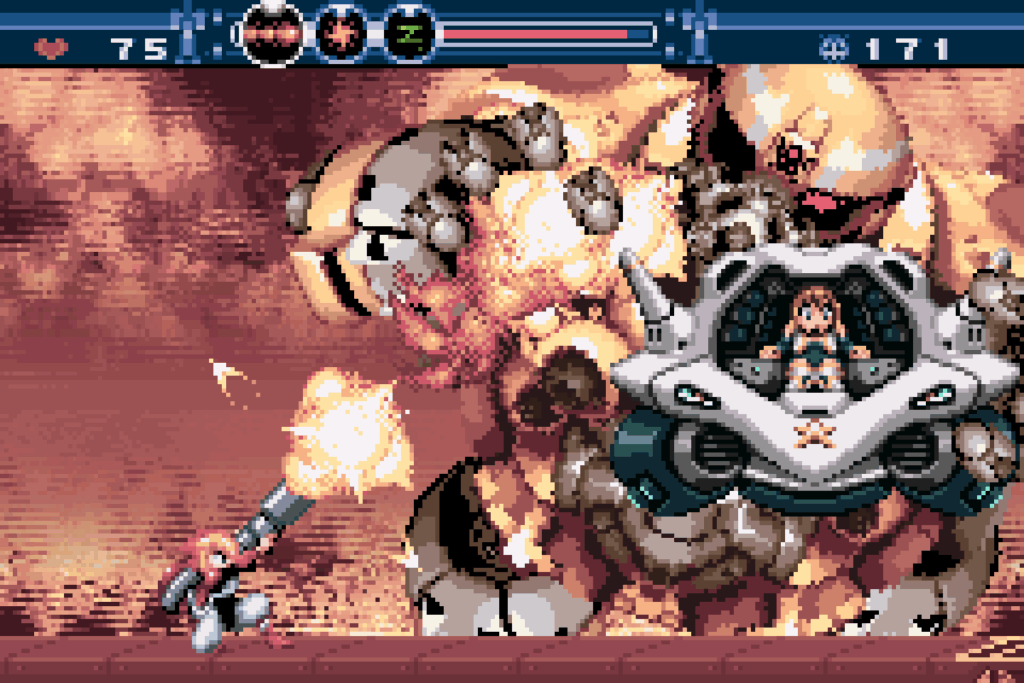
The visuals on the other hand spend no time warming up. Within the first 3 screens, which translate to about 20-30 seconds of time, you can spot sprite scaling effects, multi-part enemy sprites, multi-layer parallax scrolling and whatever is happening in the second-screen hallway. Just about everything you shoot explodes beautifully, as per arcade tradition. And all these elements combine to form the first boss fight and its over-the-top background.
Moon 1: The kitchen sink
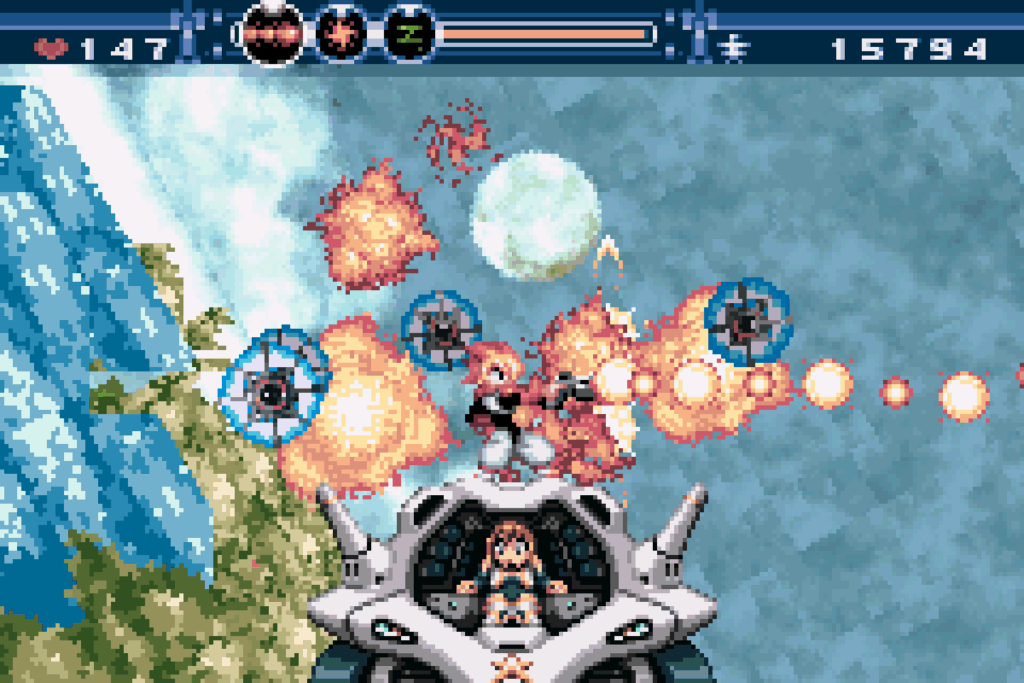
If Earth is the first taste, Moon 1 is the essence of Gunstar Super Heroes. You are immediately thrust into a new gameplay mode, one where you find yourself shooting stuff on top of a spacecraft. You can rotate the craft to dodge incoming fire but you cannot move beyond that. Visually striking, these sections are more about beefing up your score than trying to take you out.
Soon, you are back on-foot in a run and gun section that ends with a bullet hell-ish miniboss. Never one to shy away from cool optional mechanics, the game lets you juggle the enemy remains for health pickups.
The next section is a rotating maze which you must navigate to collect and save small chicks by guiding them back to the exit. While it uses the on-foot controls, the rotating nature of the maze tests a different skillset. What is even more peculiar is that this style is used once in the whole game. I count this among the successful experiments within Gunstar Super Heroes.
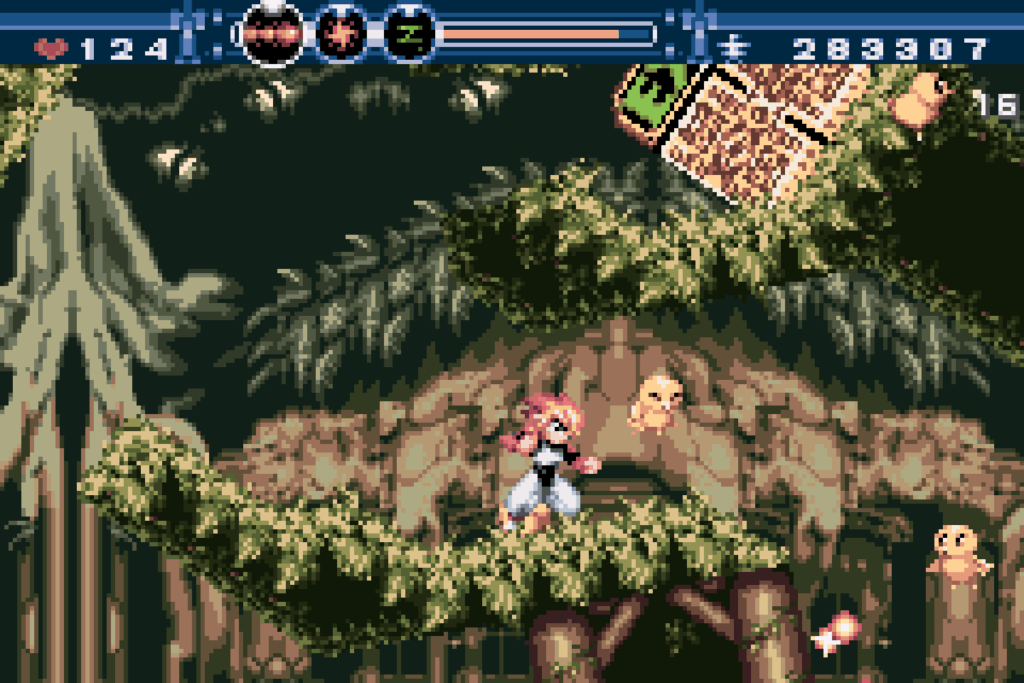
The boss of Moon 1 is Pink. This fight resides in that uncanny space that makes you wonder if you outsmarted the game or this is how the fight is supposed to beat it. This point becomes obvious in video form.
Moon 2: Shmup territory
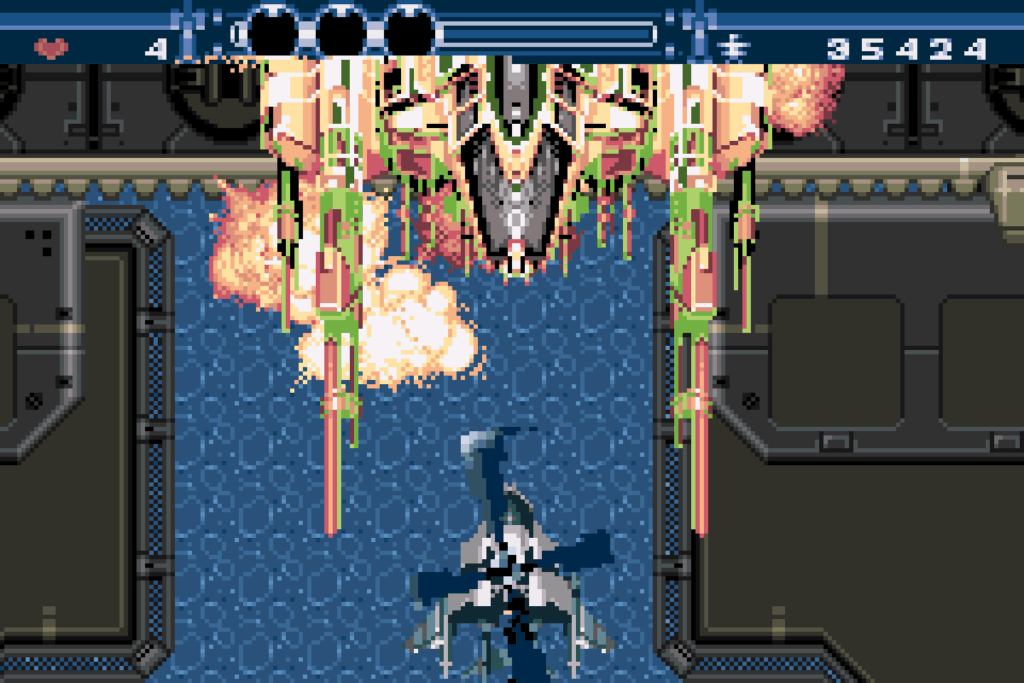
Being adamant not to let you settle into a rhythm, Gunstar Super Heroes decides to make the first half of Moon 2 a vertical shoot ’em up. There is no forced scrolling and you can angle your craft left and right with the shoulder buttons to aim the 2 types of weaponry. There is also an impressive pseudo-3D effect going on the buildings in the stage, made more apparent as you pass by them.
The lead-up to the midway boss is a worthy ride but the boss itself is what I consider the game’s first big miss. Unless you take down the supporting enemies with impressive speed and precision, the fight becomes a mess within seconds. Getting hit also incurs knockback so you can get overwhelmed pretty easily as you hurtbox is not exactly small. Thankfully, you can rush it down.
After a section that looks like a top-of-the-spacecraft gauntlet but with normal controls, you reach another midway boss encounter, the pillar men. Initially, this section was a bit of an obstacle for me but some experimentation led me to find that you can use the pillars to boost you up to a bar you can hang from, a situation that gives you much more control over the fight. Amazingly, I still largely screw up the encounter but end up barely surviving.
Orange is who you’ll be facing at the end of Moon 2. An enjoyable little battle and a good time to mention the Fire weapon. Perfect for throwing out an active hitbox a medium distance in front of you, it also happens to apply knockback to Orange. By complete happenstance, the battle takes place on top a plane, mid-flight.
Moon 3: Peak Gunstar Super Heroes
I was wary of Moon 3 when I first took control. It is an auto-scroller that allows you to change between 3 different lanes using the jump button, with horizontal movement allowed within those lanes. This can be disorienting when the stage switches to vertical sections but it ended up becoming my favorite.
Watching goons hop around a train that scrolls at different speeds while you dodge explosions and bullets is great and all but the real star is Green and his machine, Seven Force.
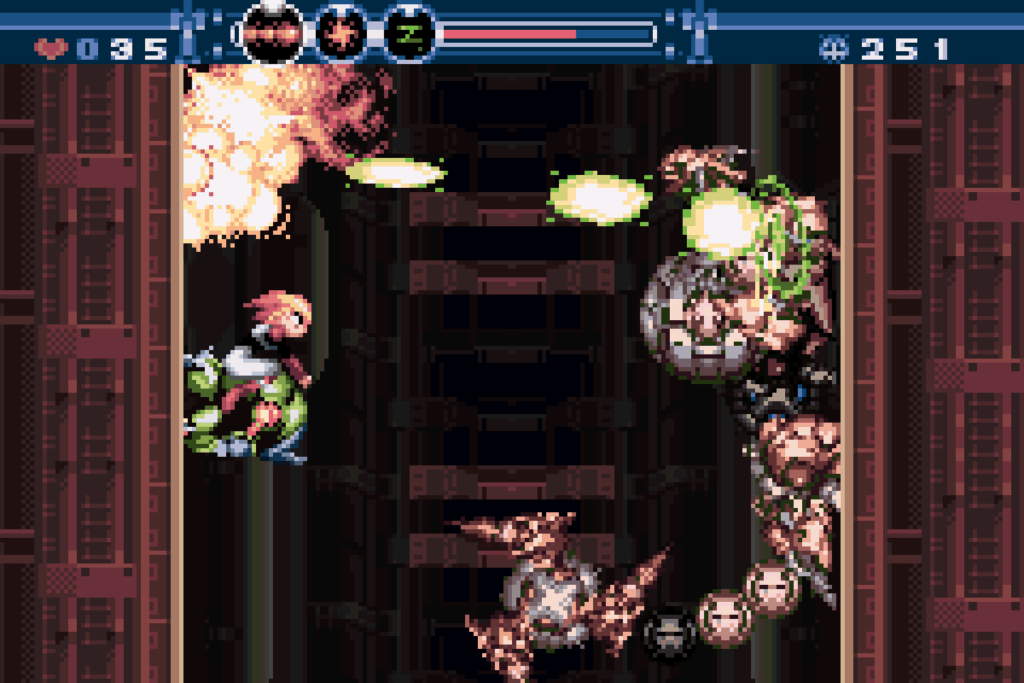
Seven Force is the boss of Moon 3 and the best thing in Gunstar Super Heroes. It has 7 different forms that act completely differently and depending on the difficulty, you may face anywhere from 3 to all 7, with the specific selection of forms being random. Besides animating beautifully, with several moving parts and his attacks being readable despite the chaos on-screen, it crams so much gameplay variety within a single fight that it is impressive, even for Gunstar standards.
Let’s take the Running Man form, for example. It starts off by shooting laser which can be countered by the Force supercharge attack. It then flies on top of the screen dropping bombs, forcing you on the bottom lane in a very shump-like bullet dodging scenario. A good time to switch to the Chaser weapon that has a homing effect, as you’ll be too busy to watch where you are shooting. For the finale, Seven Force shoots off its arms to confine you into a specific screen space, which would be the setup for a follow up attack its HP did not just run out. Not too bad for 1/7th of what is on offer in this fight.
Moon 4: Roll of the dice
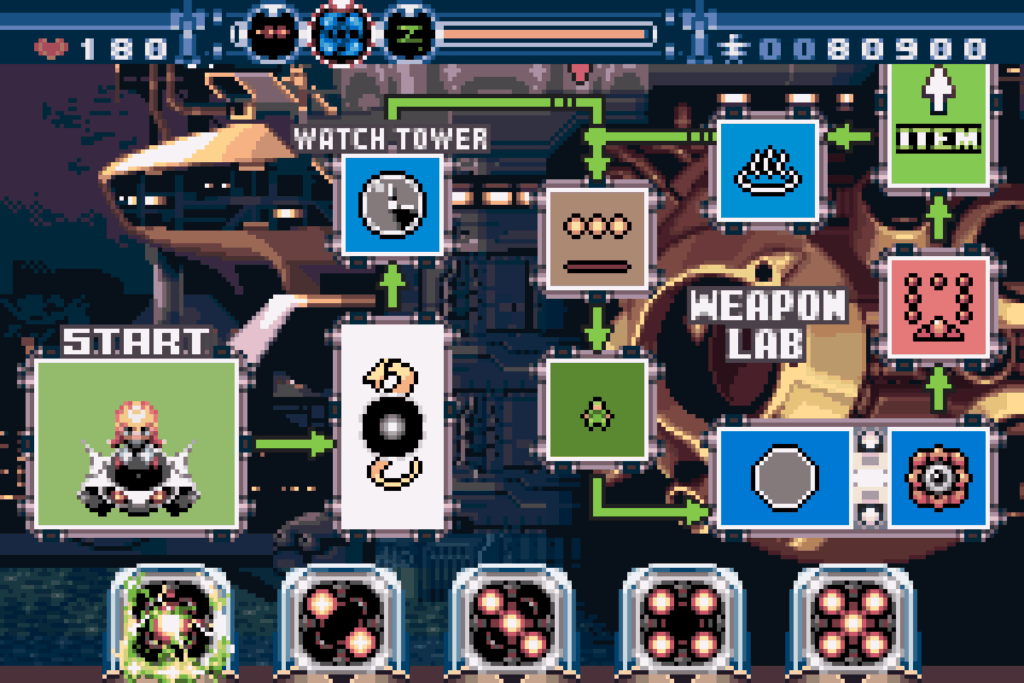
After a short intro section, Moon 4’s core makes an appearence. It a board-based stage layout where the roll of a dice determines which mini-stage you will have to play through as you progress. With proper timing, you can land on the dice side you want but variable cursor timing means that you’ll probably miss your target just as much.
It should come as no surprise that there are tailor-made assets for these mini-stages that in a different game could be stretched to whole levels or fully fledged boss fights.
There are some really off-beat designs here, with this game’s version of Melon Bread being magnificent nightmare fuel (and a better fight all around) or, should you overshoot past the final boss, there’s a meta-threat: the File Crash, which alludes, or directly states in the Japanese version, that failure means save deletion.
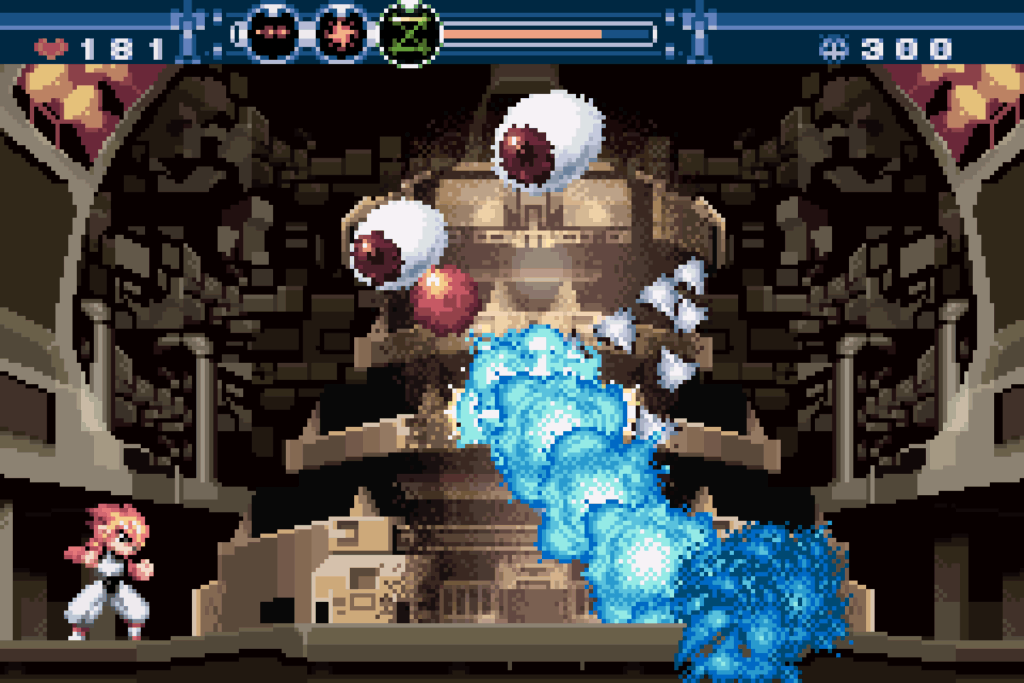
The variety is so strong that Black, the stage’s actual boss, despite being a fun encounter himself, could be feasibly passed off as the enemy you would face after landing in a mid-board square, just beefed up.
Moon 5: The lull before the storm
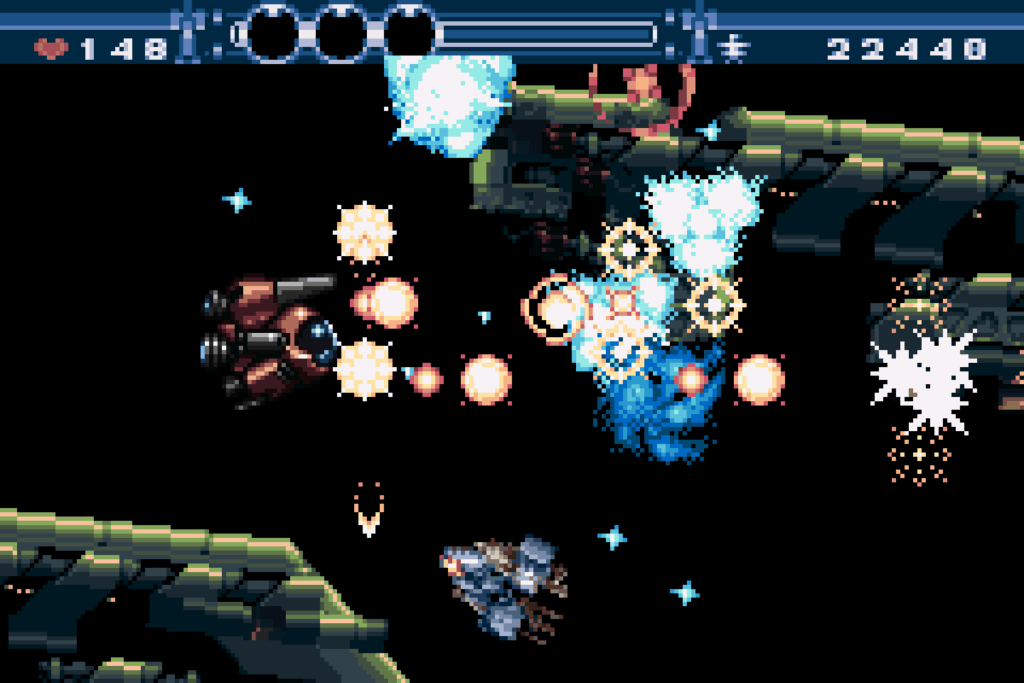
Both in narrative terms and gameplay-wise this is a transitional stage, the frontrunner for most forgettable section in the game. It is ramping up for its final showdown and we are given a mix between a horizontal and an omni-directional shmup section.
Of course, it is sandwiched between styles of gameplay we have encountered before but the spacecraft section is the showpiece, with middling results. Just like Moon’s helicopter section, the fact that Gunstar Super Heroes crams a different genre in its short runtime once again is impressive in itself. However, it being different and largely functional does not really justify its inclusion.
There is a complete lack of challenge, with enemy fire doing bizarrely miniscule damage. The bullet patterns are plain and so are your weapon options (1). However, its gravest sin is its lack of character. In such a bombastic game, a slow and forgettable slice seems particularly out of place. The fundamentals are there for something good, just completely undertuned.
G-Arc: Of course there is a boss gauntlet
A staple for games of its ilk, Gunstar Super Heroes does the boss gauntlet justice by remixing and combining previous fights to create a climax that matches the pace of the experience so far.
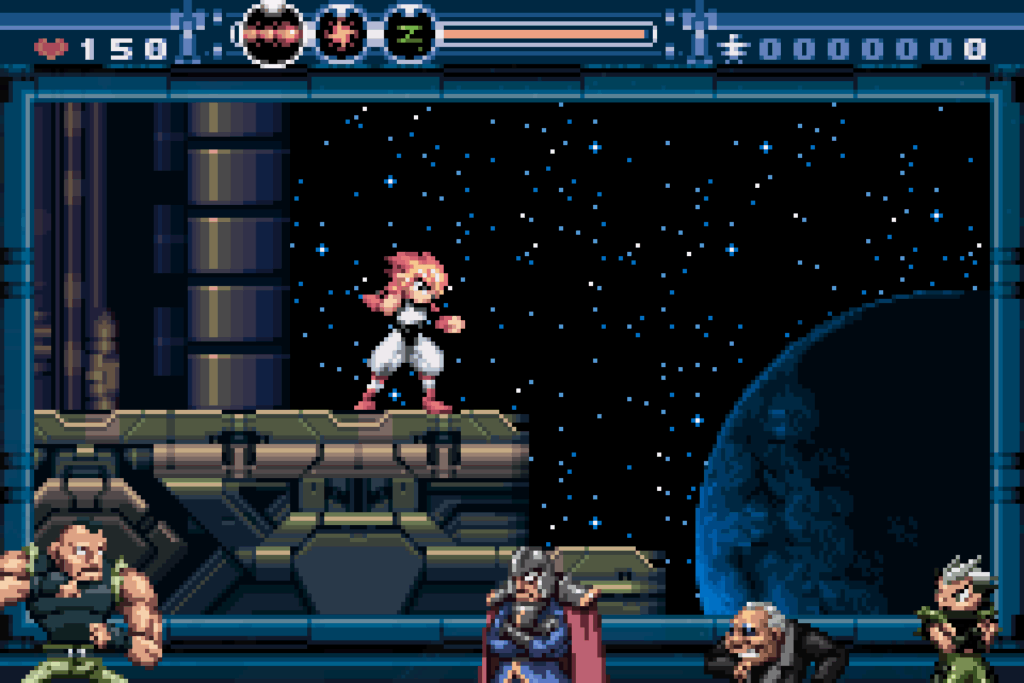
G-Arc’s first attempt to win you over is a stage overlay with each boss watching you progress through the ship, ready to enter once their turn comes. Pink’s fight is chaotic but satisfying to figure out, pushing you to engage with different weapons and hidden mechanics, like how hitting bombs with a neutral melee attack turns them into health pickups. A microcosm of what Gunstar Super Heroes is, you have 3 big, beautiful character sprites moving around on screen, vertical laser effects and an assortment of explosions.
Grey nets a more fleshed out encounter, testing if you remember rail movement exists. Black on the other hand has a new gimmick. You are meant to navigate a vertically scrolling elevator, with platforms spawning at specific places to push you to the damaging upper border of the screen. At the same time, Black summons lazers, creating another iteration of “dodge while shooting at the general direction of the enemy”.
To wrap up the gaunlet, we get a non-vehicle version of Seven Force that transforms after each attack, which makes for a frantic final fight. It is definitely sending off the game with a bang, even if transformation luck does not help me fully showcase that on video.
Well, you also get to fight Golden Silver but challenge-wise (and as far as mechanics are concerned), this is a formality.
Parting shots
1 Credit Celar
There are several tells as to what game Gunstar Super Heroes is trying to be. High score with name 3-letter name inputs, stage-based progression, difficulty selection that affects the narrative, a short runtime with a very replayable nature. This is not a one-and-done kind of game. The Game Boy Advance is not a coin-op arcade but a pseudo-1CC run feels like the natural end goal for anything inspired by the arcade experience and seemed like a good backbone to center this piece around.
Gunstar Super Heroes in context
Treasure really boosted the quality and variety of the GBA library even if their name does not always come up in top X lists. They do, however, have a hardcore following which has strong opinions on their catalogue of games.
If I were to generalize, Gunstar Super Heroes’ reputation within that community is very middle-of-the-road. Largely considered a good game with missed potential, it lives in the shadow of its elder brother, Gunstar Heroes. Not a bizarre characterization if you consider that it is functionally a reimagining of that game, with content cut and stitched together differently, often remixed and enriched with some completely new additions. Not everyone enjoyed the changes or omissions and its nature as a sequel means that it does not have the wow factor of something like its Game Boy Advance sibling, Astro Boy: Omega Factor.
As for me, I think there is much truth to the above but its comparative shortcomings are counterbalanced by how well it adapts controls and design to the handheld and I happen to be positive on a lot of the additions. I don’t know, I dig the chick level. It is a standout among the GBA library and it would be great if it can act as a gateway drug to the rest of Treasure’s catalogue.