Cracking the Code: AGB-E0? AFXP-EUR?
Somewhere between the need for cartridge verification and burning curiosity laid my desire to understand what the collection of characters printed on cartridge PCBs and labels meant.
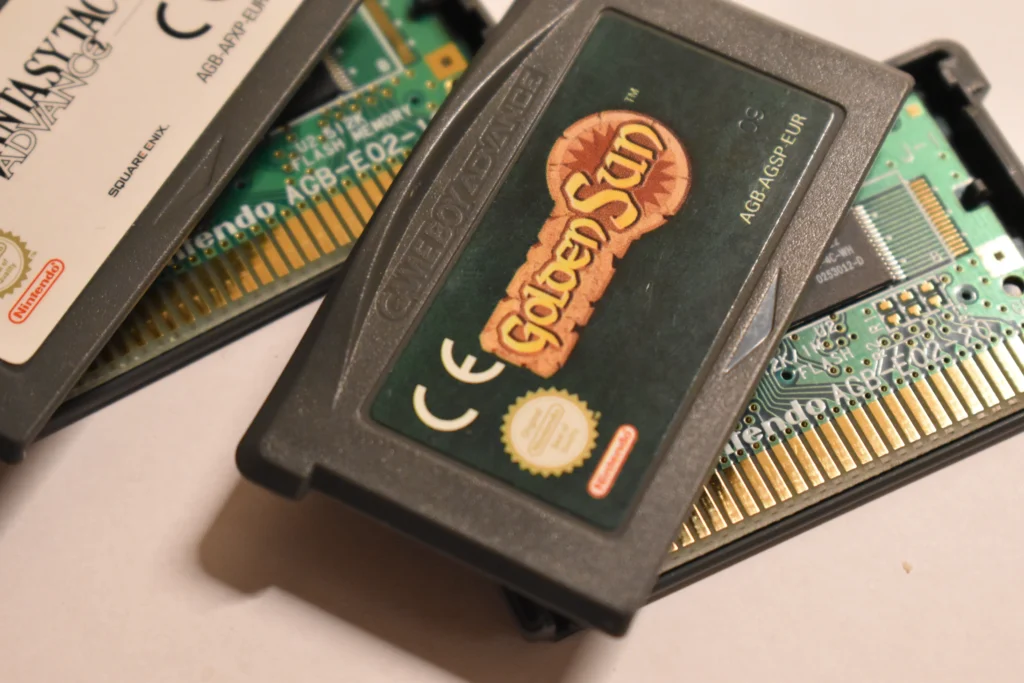
Surprisingly straightforward once you know what to look for, let’s see what the method to this madness is.
Label Code
Printed on the lower right corner of every cart label is a 10 character code, broken up into 3 sections.
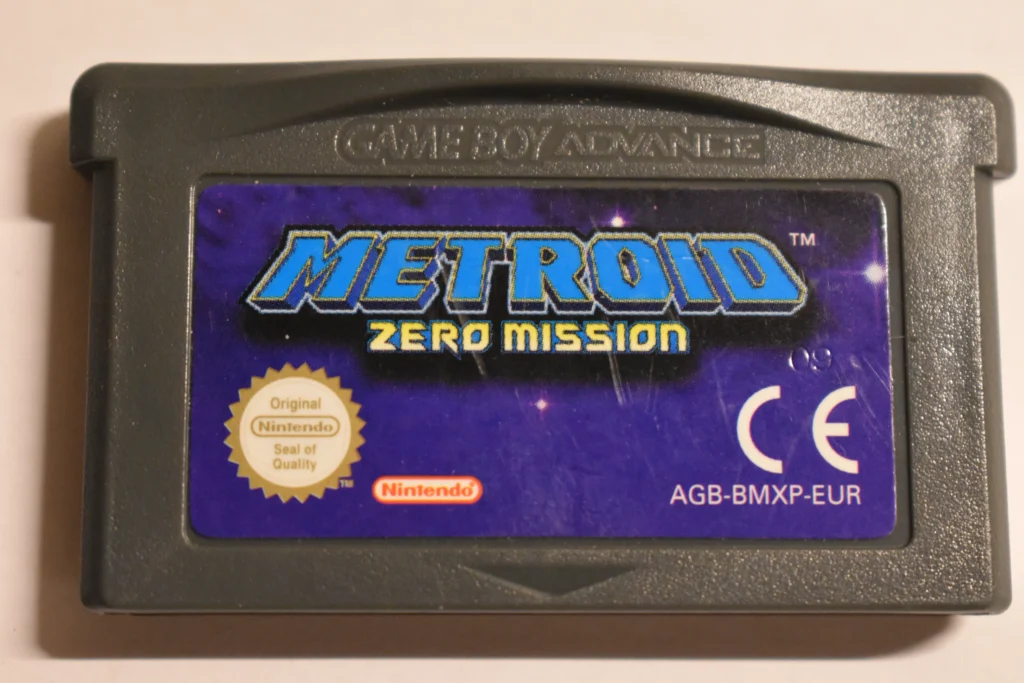
The first part is easy enough to understand. AGB is the codename for the Game Boy Advance. An Advanced Game Boy.
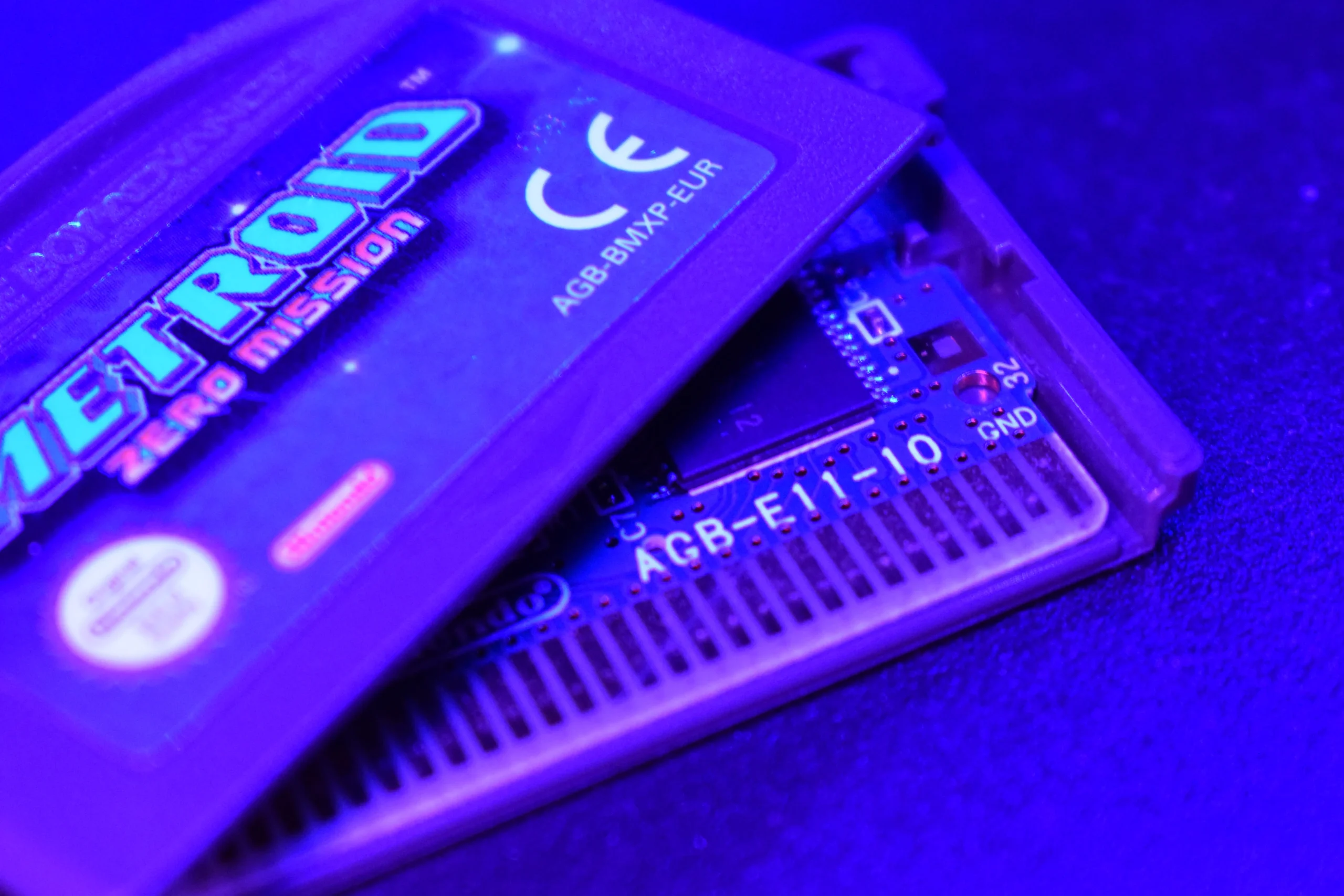
The second part needs a more detailed breakdown. Let’s take this Metroid: Zero Mission cart. The label has the code AGB-BMXP-EUR on the bottom right.
- The first letter denotes the cart type: B is one of the standard types. Other examples include U for the Boktai game PCBs that have the solar sensor and F for the Famicom line of ports.
- The second and third letters act as a unique game code: MX is Zero Mission. Mario Gold: Advance Tour gets the letters MG. The seems to be a relationship between the title’s initials and the letters assigned but it is loose.
- The fourth letter refers to the region. In my Zero Mission’s cart case, P means that its the European Multilingual release.
The third section is also quite easy to grasp as it is referring to the packaging region. Guess which region EUR is.
You can find a great, detailed breakdown in this site.
PCB Code
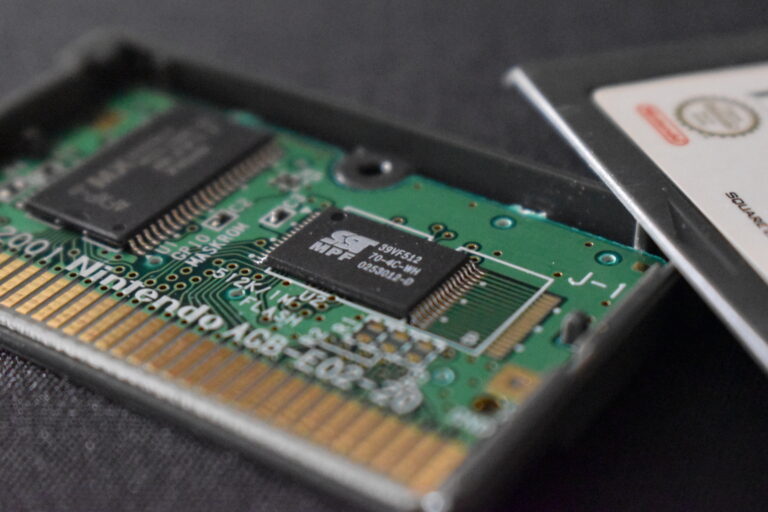
Here is where things get more interesting. Printed on the circuit board of our GBA games is a code that has a similar structure to the label one but has completely different second and third sections. Let’s use Final Fantasy Tactics Advance and Golden Sun to elaborate. The first gives us AGB-E02-20 while the latter gets AGB-E02-10. The AGB denotes the same thing as the equivalent part on the label code.
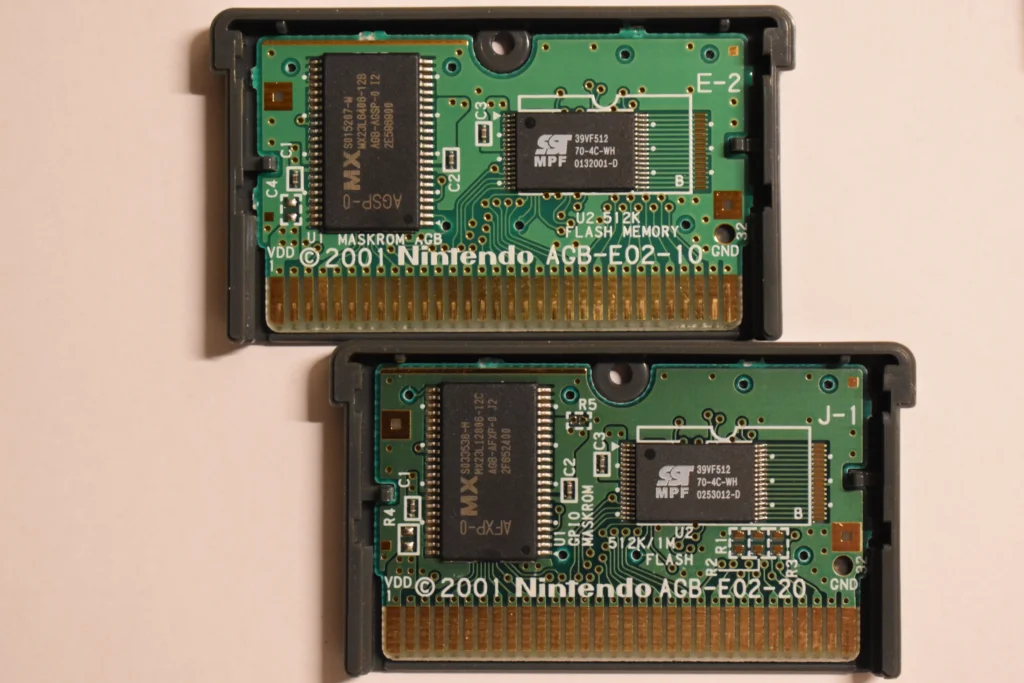
Here, the middle section takes the form of “EXX” and it is used to denote the board type. Therefore, all boards with the same alphanumeric will largely share the same specs. In this case, all AGB-E02 boards are flash memory boards.
The third section gives us the board revision. What collective internet reverse engineering tells us is that revisions that are denoted by a change on the first digit are minor while, just like our case, ones that bump up the second digit are bigger.
As you can see, the 10 board has no resistors while the 20 board has 5 (R1-5). More over, one capacitor, C4, does not survive the refresh. There are changes to some thru traces as well.
This site by Gekkio and contributors has a section that acts as a database for GBA games and the corresponding PCBs. There are some plans for ROM to have a similar section but it is quite likely that any boards that appear here will also be submitted in the Game Boy hardware database
A code-to-board overview can be found on gameverifying.com, here.
Sourcing
The info you have been reading has been gathered from personal verification using my own carts and from the sources linked above along with several forum posts that made great efforts to archive, reverse engineering and and repair GBA games throughout the yars.
Nintendo and their manufacturing partners were not going to come out and say “this is how our hardware works” but at least the components and design is straightforward enough and have been extensively analyzed.
More to come
This analysis was consciously decoupled from archival tables, which are best tackled as a standalone page. A more in-depth effort in terms of matching game versions to their corresponding codes is in the works.
Link rot and the demise of competent search engines is, as usual, the enemy so hopefully this piece can help people on their way to finding and verifying info on these tiny pieces of plastic and silicone.