
Mario Golf: Advance Tour – Golden Par
Depending on when you grew up, Camelot is either the Golden Sun or the Mario sports developer (or the Shining Force guys but give me a pass here). Advance Tour is functionally the nexus between these two sides, an golf title that blends arcade golf with RPG elements.
It is not their first take on the series but it is the most fully fledged example of this era of Mario Golf. Find any old forum post discussing the title and it is very likely to characterize is as either a hidden gem or an example from which future titles should take a cue.
What is more interesting, beyond how well these 2 worlds cross over, is how Camelot’s background as an RPG developer served them well in terms of providing a learning framework for the player.
A familiar course

Mario Golf: Advance Tour’s RPG influence does not start with its map and level structure. In fact, the layout of the world feels like a 2D Mario game overworld but with a central hub. Instead of levels, you have your main golf courses, optional side challenges and shops, all just a quick walk away from said hub, though many are locked behind certain progression obstacles.
Choosing to tackle any course will put you in a familiar position if you have ever tried a golf game before. Skipping the terminology, each course will have several holes and you need to complete each one within a certain number of strokes. You can control your shot’s general trajectory, it’s curve, the contact point, the club that will be used and your accuracy based on a timing minigame. Wind, terrain type and slopes all need to be taken into account.
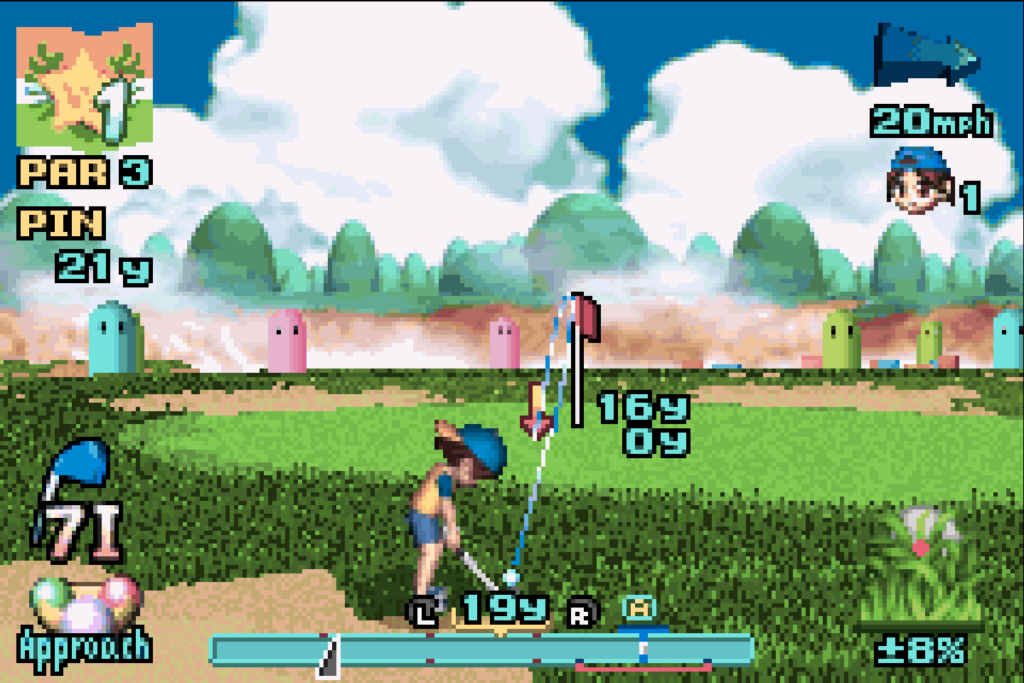
And all that makes for a fine experience. What sets Advance Tour apart is that you can earn experience that results into stat points upon level up, which can affect almost all aspects mentioned above. Couple that with the option to get different clubs from the shop and the RPG aspects start to have a considerable impact on what you character can achieve within the course.
These boosts do not overshadow the core mechanics and you don’t need grinding to go through the game. But what these RPG tropes and abstractions achieve, possibly unintentionally, is nudging you into learning golf concepts without holding your hand. And the sport has a fair amount.
Getting tricked into learning
The traditional RPG ritual of talking to people in town to find the next step or the use of some item is repurposed in Advance Tour to plant seeds in your brain about certain mechanics. You are then lightly pushed to try out tutorial disguised as small challenges. These are naturally found while walking around the different courses and reward you with experience points upon completion.
The result is a well-paced learning experience that unfolds organically. For example, one of my biggest failings early on was overshooting my approach shots, which are meant to land you on the putting green, near the hole. Some NPC mentioned a backspin shot and that sounded like something I could use but they stopped short of explaining how to do it. Off to walk around the course and talk to “pros”.
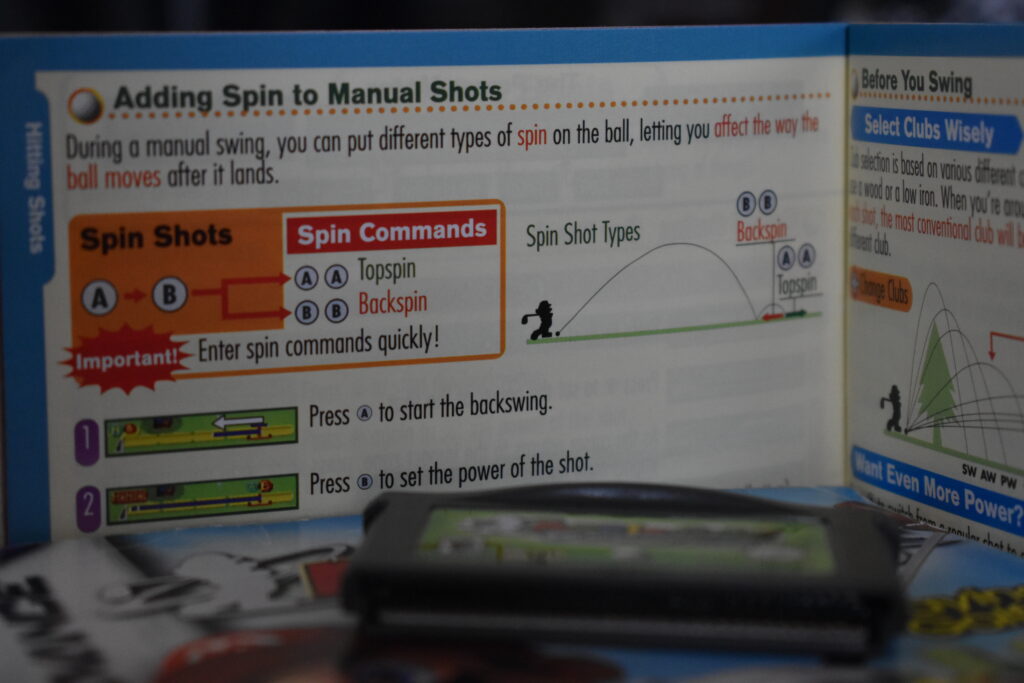
Sure enough, one of the challenges aimed to help with the approach shots had a backspin tutorial in it and it became probably the most valuable tool in the game. Valuable enough to help me beat one of the challenge courses and earn me ticket for a custom club.
Rushing to the shop to exchange it for a club, I noticed that there is a low-fly club. Why would I want my shots to go lower? I am trying to go over those pesky trees most of the time. Curiously, there is also a stat for this, as if there are pros an cons to height.
In hindsight, it might seem obvious that high shots would be affected by wind more. That could be said for a dozen of this game’s mechanics. But without the RPG-shaped trail of crumbs that leads to the information or application, people who don’t have already have an investment in golf-related gameplay systems might drop the game before these have time to shine.
Byproducts of an unholy marriage
There is particular novelty in having a Motoi Sakuraba soundtrack accompanying a Mario Golf game. The Palm’s tournament OST could slot into any RPG of the era seamlessly. But the tense track that pops up the moment you are in a par putt situation, akin to what you would expect to play in the last phase of a boss battle, is probably the first time the genre fusion really landed.
The game also has its own version of going back to starting areas and feeling overpowered, with a boosted drive stat, and a decent amount of skill, allowing for some hole-in-ones that are actually more effective at putting your growth into perspective.
The other side of the coin, where the arcade experience takes the lead, is how you can skip a lot of the adventure and just select the activity you want to do in the main menu. It feels weird to be able to do that, given the care put into that side of Advance Tour, even if it can come in handy.
However, the most surprising and welcome feature is a quite robust, for the time, replay system. Without it, I wouldn’t be able to showcase the first time I understood and applied mechanics like aiming for an incline on a putting green to limit bounces and a backspin to account for overshooting.
Sinking the putt
Conveying what make a golf game good is hard, as I learned while writing this. Beyond features that come with the actual game of golf, what you are actively doing in these games, after weighing the impact of several variables, is moving a line and playing a simple timing minigame based on a gauge.

That is why this article focused on how well the game gets you give the concept of the sport a chance by utilizing its RPG side. Case in point, Advance Tour was an impulse buy. A combination of a good price tag and the realization that the ROM collection lacks an NTSC complete-in-box copy of a GBA title. It had absolutely nothing to do with any preexisting interest in golf. Yet, a couple of weeks later, Neil’s room is looking pretty crowded.